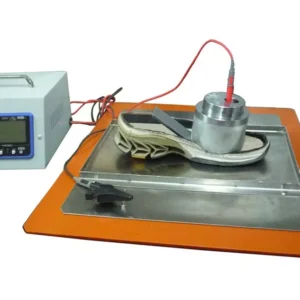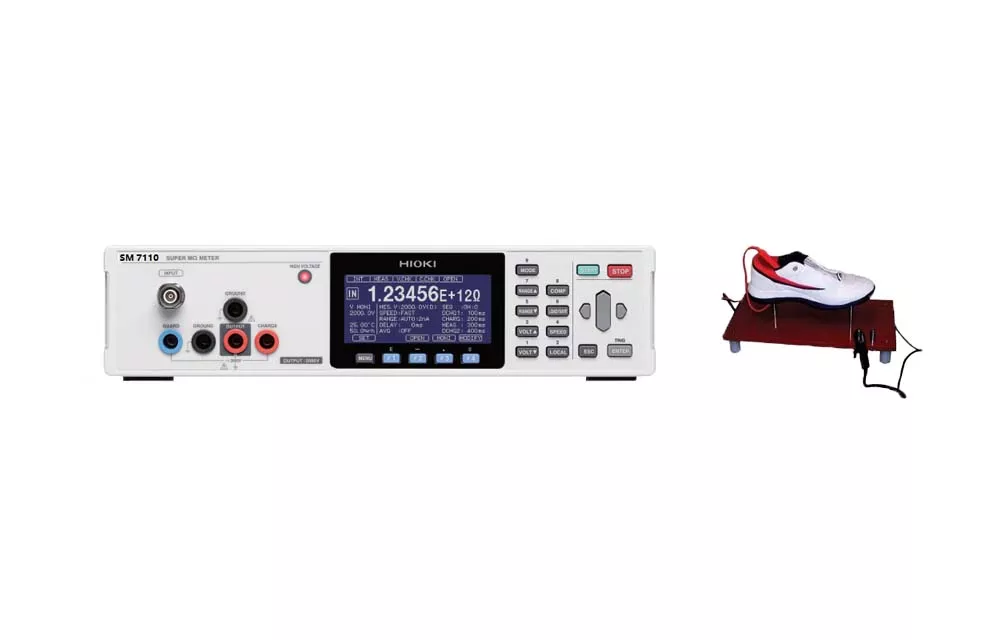
The antistatic meter uses a voltage and current circuit consisting of a fixed voltage power supply section and a high-sensitivity current testing section. The current testing section is composed of a current detection impedance, a low-drift voltage amplifier, and an integrating A/D converter. The impedance test value is calculated by the CPU and displayed on the panel.
It is suitable for testing the antistatic properties of shoes and can be used for different types of footwear, including conductive shoes and antistatic shoes.
The antistatic meter can be adjusted in a dry environment to measure the resistance of conductive shoes, and adjusted in both dry and humid environments to measure the resistance of antistatic shoes.
Using a voltage-current circuit combination, this configuration may provide more accurate and sensitive testing.
It includes a highly sensitive current testing section, which helps to measure the resistance of electrostatic dissipative shoes.
The current testing section includes a low-drift voltage amplifier, which helps reduce measurement errors.
Using an integrating A/D converter can provide high resolution and accuracy for measurements.
Antistatic instruments are used during the manufacturing process to ensure that the shoes produced meet relevant antistatic performance standards and specifications.
This ensures that products comply with relevant industry standards and regulations, reducing risks and improving market compliance.
An antistatic instrument is a crucial tool for ensuring that the antistatic performance of shoes meets relevant standards. This helps ensure that manufacturers can provide products that meet compliance and quality standards, especially in sensitive environments requiring static electricity control, such as semiconductor manufacturing.
If you have any further questions or needs regarding antistatic instruments or other related equipment, please feel free to contact us.
We are dedicated to providing you with professional support and solutions.
The combination of features, including a voltage-current circuit, a high-sensitivity current test section, a low-drift voltage amplifier, and an integrating A/D converter, provides highly accurate measurements.
Through CPU calculations, impedance test values can be intelligently calculated, improving the intelligence of the test and helping to improve the accuracy of the test.
The panel instantly displays the impedance test value calculated by the CPU, allowing users to quickly understand the test results.
| Voltage range (DC) | Maximum display | Resolution | Voltage measurement indication error: ±%rdg. ±dgt. |
| 10V | 10.000V | 0.001V | 0.03 +2 |
| 100V | 100.00V | 0.01V | 0.03 +2 |
| 1000V | 1000.0V | 0.1V | 0.03 +2 |
| Current range | Maximum display | Resolution | Current indication error: ±%rdg. ±dgt. |
| 200pA | 199.999pA | 1fA | 1+30 |
| 2nA | 1.99999nA | 10fA | 0.5+20 |
| 200nA | 199.999nA | 1pA | 0.5+10 |
| 2μA | 1.99999μA | 10pA | 0.5+10 |
| 20μA | 19.9999μA | 100pA | 0.5+10 |
| 200μA | 199.999μA | 1nA | 0.5+10 |
| 2mA | 1.99999mA | 10mA | 0.5+30 |
| Resistance range | 50Ω~2×10¹⁹ Note: Resistance measurement accuracy is specified by current and voltage accuracy standards. | ||
| Accuracy guarantee conditions | Operating ambient temperature: 23℃±5℃, 20%RH~80%RH ±5%RH | ||
| Preheat for at least 30 minutes after powering on. | |||
| Operating power frequency range: 50Hz/60Hz ±2Hz | |||
| Temperature coefficient: 0-18℃, 28-40℃, plus ±[measurement accuracy × 1/10]/℃ | |||
| power supply | 1∮AC 220V 50/60 Hz | ||
Villa Payung Indah B 27, Jawa Tengah, Pudakpayung, Kec. Banyumanik, Kota Semarang, Jawa Tengah 50265
Copyright 2023 Amtast Multisado