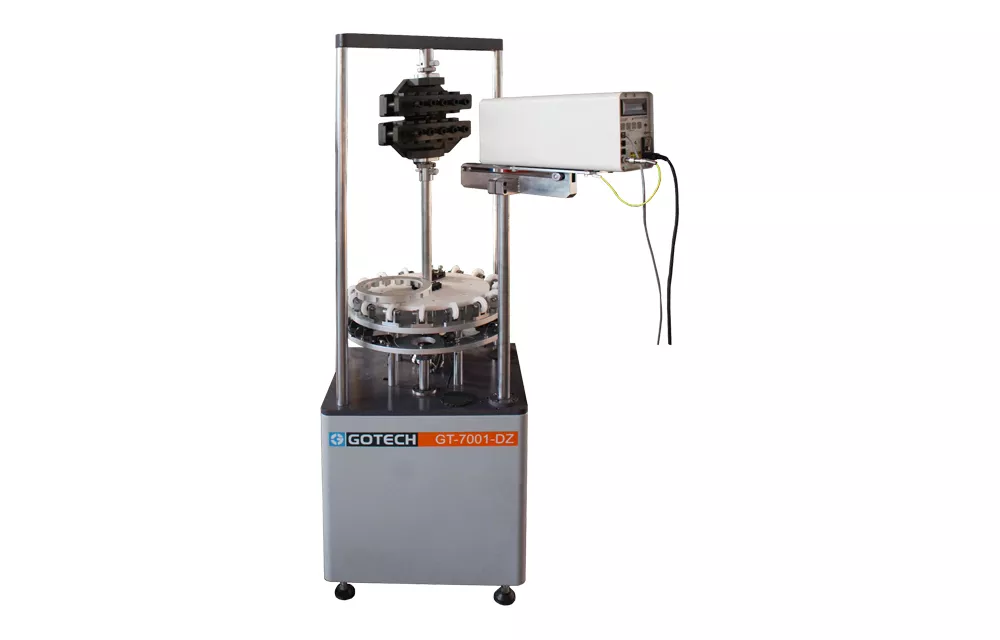
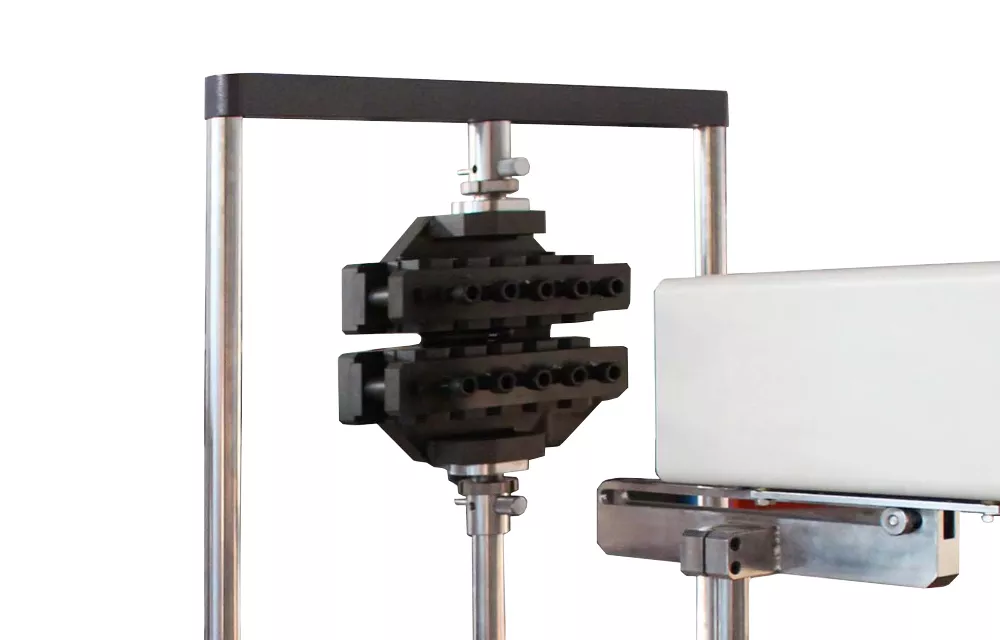
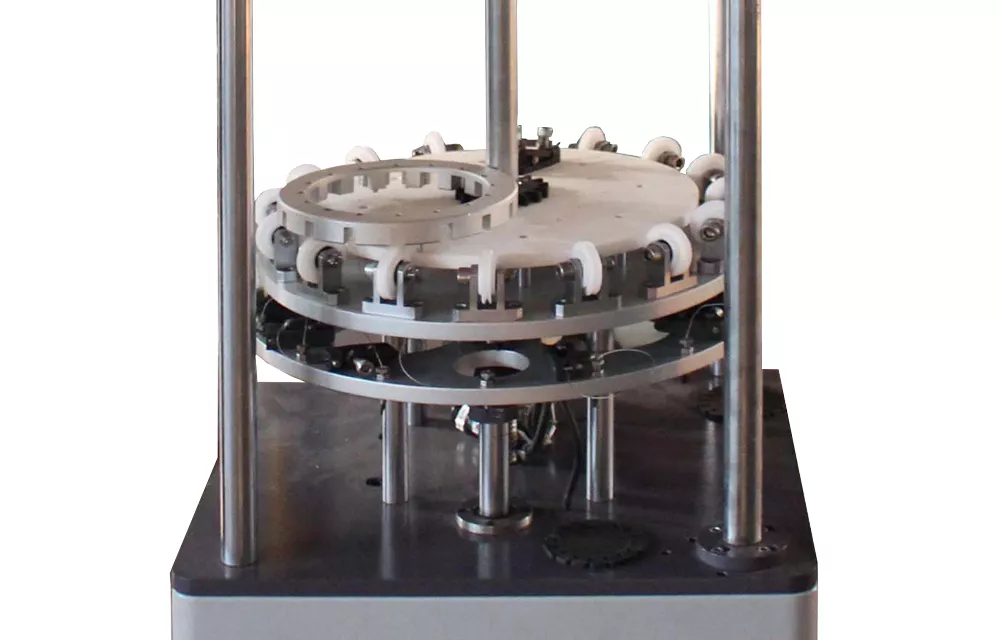
A frictionless uniaxial compression test was achieved, which can also be realized through an equivalent biaxial tensile test. The biaxial tensile test involves applying loads at 16 evenly distributed points on a circular thin plate with negligible thickness. The load magnitude is measured using a force sensor, and the elongation deformation under the corresponding load is measured using a non-contact laser extensometer. The relationship between engineering stress and engineering strain is then derived using formulas. For
uniaxial tensile testing, a fixture is added to the original machine. The machine moves vertically, stretching a transverse rubber specimen. The force is sensed by a force sensor, and the elongation is sensed by a laser extensometer. The stress-strain relationship of the transverse rubber specimen is then derived.
Research and development of rubber materials and products, material performance evaluation, tire industry, sealing components, aerospace industry, etc.
This testing machine supports biaxial tensile testing, allowing researchers to simultaneously evaluate the properties of rubber materials in two directions, which is crucial for a comprehensive understanding of material behavior under multiaxial stress.
The equipment features an added clamp design, enabling uniaxial tensile and frictionless uniaxial compression experiments, providing greater experimental flexibility to meet diverse research needs.
It can perform biaxial tensile tests, making the test results closer to the actual application scenario and helping to predict the performance of materials under actual working conditions.
Biaxial tensile tests can provide the relationship between stress and strain in circular thin plates under different loads, which helps to establish engineering stress-strain curves.
Advanced sensors and laser extensometers (sold separately) enable accurate measurements of loads and deformations, providing high-quality experimental data that aids in the accurate analysis of material properties.
Using a laser extensometer (sold separately) for non-contact strain measurement avoids sample interference and improves data reliability.
The computer-controlled biaxial tensile testing machine for rubber and other materials offers comprehensive performance evaluation of rubber materials and provides researchers with abundant experimental data, contributing to a deeper understanding of the mechanical properties of rubber materials.
If you have any further questions or needs regarding the computer-controlled biaxial tensile testing machine for rubber and other materials or other related equipment, please feel free to contact us.
We are dedicated to providing you with professional support and solutions.
The operating software for high-speed rail testing instruments is independently developed. The computerized operating interface allows for flexible setting of test parameters to meet the requirements of different applications and standards.
It can monitor and record data in real time during the testing process, enabling users to understand the progress and results of the test in a timely manner.
It has data recording and storage functions, which makes it convenient for users to retrieve and review previous test results, and helps to analyze material properties.
| Force sensor capacity | 500kg |
| Control method | Computer + dedicated testing software |
| Force decomposition | 1/200,000 |
| Force Precision | ± 0.5% |
| Speed range | Adjustable from 0.01 to 500 mm/min |
| Speed accuracy | ± 0.5% |
| stretch stroke | 80mm |
| Displacement resolution | 0.00004mm |
| Unit switching | kg、lb、N、kN等 |
| Deformation sensing | Laser extensometer (sold separately) |
| Volume (approximately) | 500x500x1500 mm (excluding computer) |
| power supply | 1∮ AC 220V 50/60Hz |
Villa Payung Indah B 27, Jawa Tengah, Pudakpayung, Kec. Banyumanik, Kota Semarang, Jawa Tengah 50265
Copyright 2023 Amtast Multisado