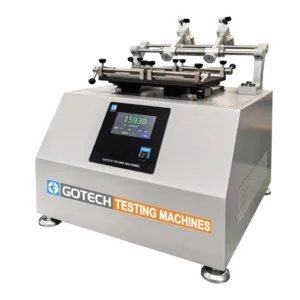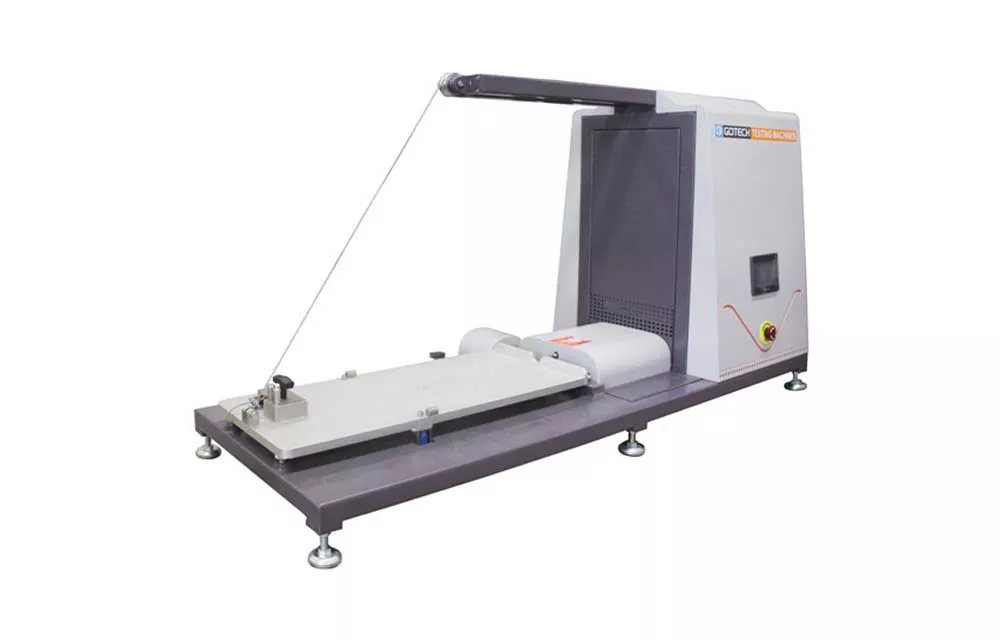
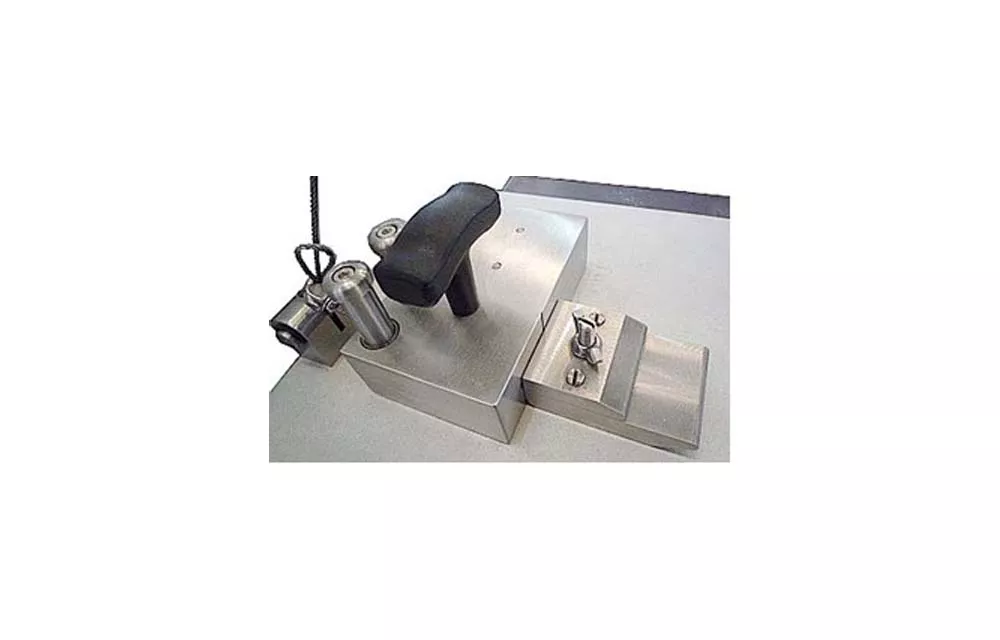
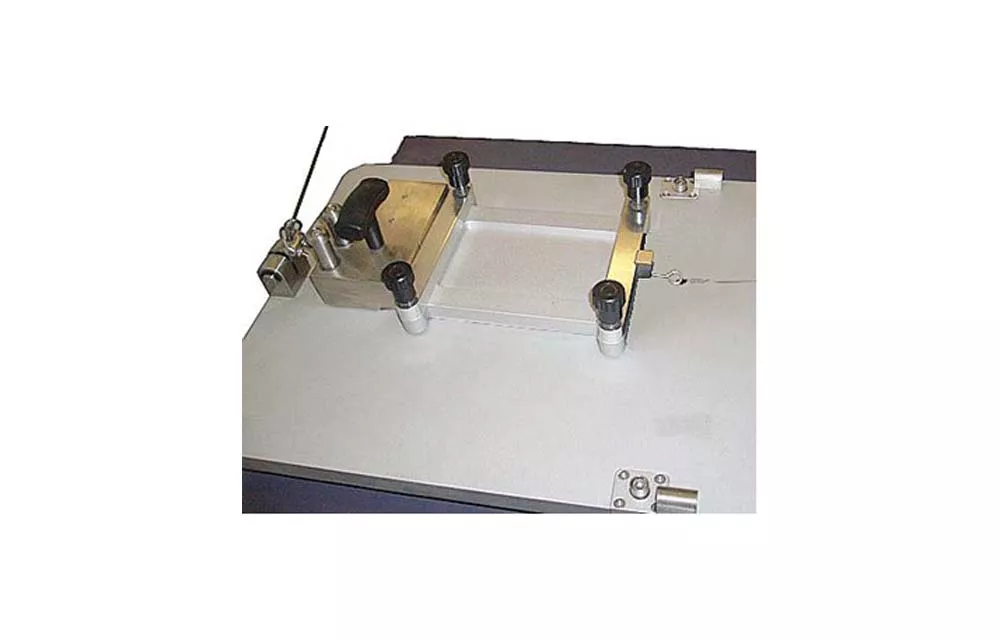
The shoe lining friction performance tester is mainly used to evaluate the friction performance of various shoe linings and insoles.
A rectangular lining or padding material surface layer is mounted on a sliding device, which moves on a securely mounted horizontal platform.
One end is connected to a force sensor, while a control material (such as wool, lining, or padding itself) is fixed to the platform.
The forces that initially cause the sliding device to move and the forces that maintain a constant velocity are measured.
The static friction coefficient (μs) and kinetic friction coefficient (μk) are calculated using computer software, and the test curves are plotted.
Place the sliding device with the lining or padding sample mounted on it on a woolen platform, raising the platform at a certain angle to the horizontal plane.
Gradually increase the angle of the inclined plane until the sliding device can slide down the inclined plane. Measure the inclination angle of the inclined plane and record this angle as the static angle Ds of the surface resistance.
Place the sliding device with the lining or padding sample mounted on the platform, raise the platform to an angle 5° smaller than Ds, and push the sliding device with a force of approximately 3N. Use a photoelectric sensor to detect whether it can slide freely down 200mm.
Increase the inclination angle by 1° each time, repeating this operation until the sliding device can slide freely 200mm. The inclination angle of the platform at this point is the dynamic angle Dk of the surface resistance.
During the manufacturing process of shoe linings, it can be used to evaluate the friction properties of different materials, helping to select the most suitable material to improve the performance and comfort of shoe linings.
During the new product development phase, it can be used to evaluate shoe linings with different designs and structures to ensure that they have good friction performance in actual use and meet user needs.
It can be used to evaluate the static friction coefficient, dynamic friction coefficient, static angle, and dynamic angle of different shoe lining materials, thereby gaining a comprehensive understanding of their performance under different conditions.
This ensures that products comply with relevant industry standards and regulations, reducing risks and improving market compliance.
The shoe lining friction performance tester offers comprehensive friction performance data, flexible adjustments, and a wide range of applications, making it an important tool for material evaluation and product development.
If you have any further questions or needs regarding shoe lining friction performance testers or other related equipment, please feel free to contact us.
We are dedicated to providing you with professional support and solutions.
It provides a dual testing method that can simultaneously test the static friction coefficient, dynamic friction coefficient, static angle, and dynamic angle to comprehensively evaluate the friction performance of shoe lining materials.
The two testing methods simulate static and dynamic friction on the platform, as well as static and dynamic scenarios on an inclined plane, providing data for more usage scenarios.
Using photoelectric sensors ensures accurate measurement of the material’s sliding behavior, improving test accuracy.
The operating software for high-speed rail testing instruments is independently developed. The computerized operating interface allows for flexible setting of test parameters to meet the requirements of different applications and standards.
It can monitor and record data in real time during the testing process, allowing users to understand the progress and results of the test in a timely manner.
It has data recording and storage functions, which makes it convenient for users to retrieve and review previous test results, and helps to analyze material properties.
| Testing System | U62 |
| Speciman Size | 250×100mm |
| Total weight of slider | 700±15g |
| Sensing device | LOAD CELL |
| Capacity | 50kgf,Accuracy 0.25% |
| Displacement sensor | Rotary encoder |
| Speed And Stroke | 800±100mm/min ,stroke 400mm |
| Test System | HMI+PLC |
| Speciman Size | 250×150mm |
| Total weight of slider | 300±5g |
| Tilting speed of platform | 15±2°/min |
| Sensor of tilt angle | Rotary encoder |
| Microswitch thrust | 40mN~80 mN |
| Dynamic thrust of slider | 3N |
| Dimension(W×D×H) | L150cm×W50cm×H80cm |
| Weight(approx) | 150kgf |
| Power | 1∮220V,50/60Hz(or specify) |
Villa Payung Indah B 27, Jawa Tengah, Pudakpayung, Kec. Banyumanik, Kota Semarang, Jawa Tengah 50265
Copyright 2023 Amtast Multisado