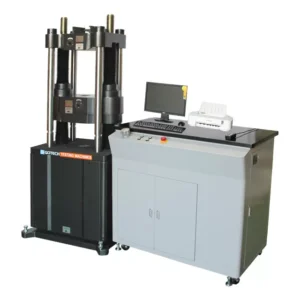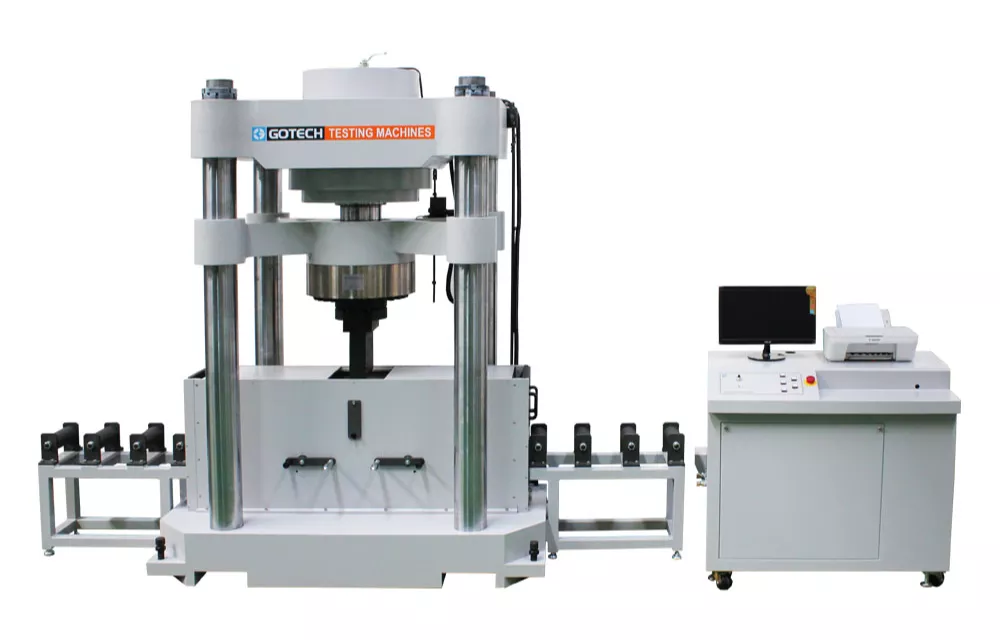
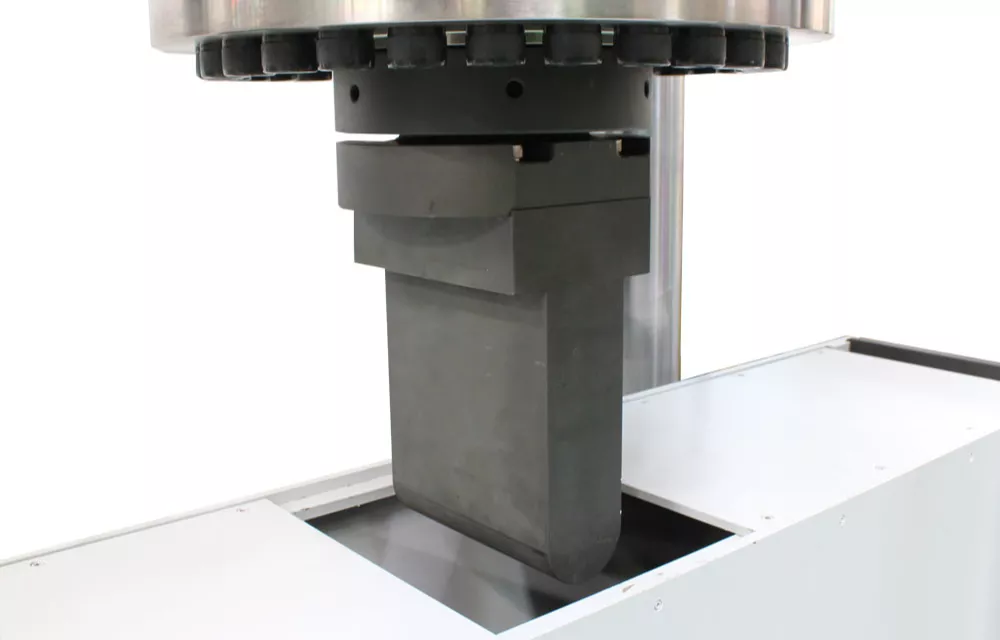


The working principle of a dedicated rail bending resistance testing machine is to simulate the complex bending forces experienced by rails in actual operation to thoroughly evaluate the bending resistance of rail materials. This testing process aims to realistically simulate the forces exerted on rails when trains pass, providing detailed performance data to ensure superior performance in real-world transportation environments.
During testing, rail samples are precisely clamped in the testing machine’s fixtures, and then a controlled bending force is applied to simulate the external bending load faced by the rails in actual operation. Simultaneously, sensors record changes in stress and strain in real time, capturing the rail’s response during the stress process.
This testing process considers not only static loads but also dynamic factors, such as the varying loads when trains pass. The data provided by the testing machine reveals the bending behavior of rail materials under different stress levels, including maximum bending degree, deformation characteristics, and springback, thus providing valuable reference for designing and manufacturing more durable and safer railway structures. The results of this simulation test are crucial for ensuring the long-term stable operation of railway transportation systems.
Primarily used in railway engineering and related fields, it is used to evaluate the bending performance of different types of rails to ensure the safety and durability of railway transportation systems.
This testing machine is carefully designed to simulate the stress conditions of railway tracks under actual use, ensuring that the test results are closer to the actual working conditions.
Equipped with high-precision force and deformation sensors to accurately measure the bending deformation of rails under stress, providing precise data on bending performance.
The Leader II operating software, independently developed by the high-speed rail testing instrument, is pre-set with industry standards such as GB, ASTM, and ISO, and provides editable user permissions to meet the data processing needs of customized tests.
It has data recording and analysis functions, can record test data in real time, and provides analysis tools to evaluate the bending performance of rails.
This ensures that products comply with relevant industry standards and regulations, reducing risks and improving market compliance.
The rail-specific bending resistance testing material machine is hailed as a key tool in the railway transportation system. Its existence and operation not only ensure the excellent performance of rail materials in actual operation but also improve the reliability and safety of the entire railway transportation system.
If you have any further questions or needs regarding the rail-specific bending resistance testing material machine or other related equipment, please feel free to contact us.
We are dedicated to providing you with professional support and solutions.
Designed specifically for testing the bending resistance of rail and other track materials, ensuring that the testing process matches the actual application scenario.
To ensure uniform stress during the testing process and better simulate the bending deformation of the rails under actual conditions.
The servo control system, through high-precision control algorithms and feedback mechanisms, can achieve precise control of loading and deformation during the experiment.
The operating software for high-speed rail testing instruments is independently developed. The computerized operating interface allows for flexible setting of test parameters to meet the requirements of different applications and standards.
It can display data during the testing process in real time, such as tensile force and deformation, allowing users to monitor sample performance in real time.
It has data recording and storage functions, which makes it convenient for users to retrieve and review previous test results, and helps to analyze material properties.
| capacity | 3000 kN |
| Test force resolution | 1/500,000, no frame rate splitting and constant resolution throughout. |
| Test force indication error | Less than ±1% |
| journey | 300 mm |
| Test speed (no load) | 0.7~1.2 mm/s |
| Load speed | 40~120KN/S |
| Speed control accuracy | Set speed (less than) < 10% Maximum speed: ±1%; Set speed (greater than or equal to) ≥ 10% Maximum speed: ±0.5% |
| Center distance of rail bending support points | 1000±5 mm |
| Rail bending support point R angle | 40mm |
| Rail bending cutter R angle | 40mm |
| Machine dimensions (W×D×H) | 312 cm×100 cm×240 cm |
| Control box dimensions (W×D×H) | 127 cm×83 cm×100 cm |
| Weight (approx.) | 8200 kg |
| power supply | 3∮ AC415V 32A (depending on country or specific requirements) |
Villa Payung Indah B 27, Jawa Tengah, Pudakpayung, Kec. Banyumanik, Kota Semarang, Jawa Tengah 50265
Copyright 2023 Amtast Multisado