
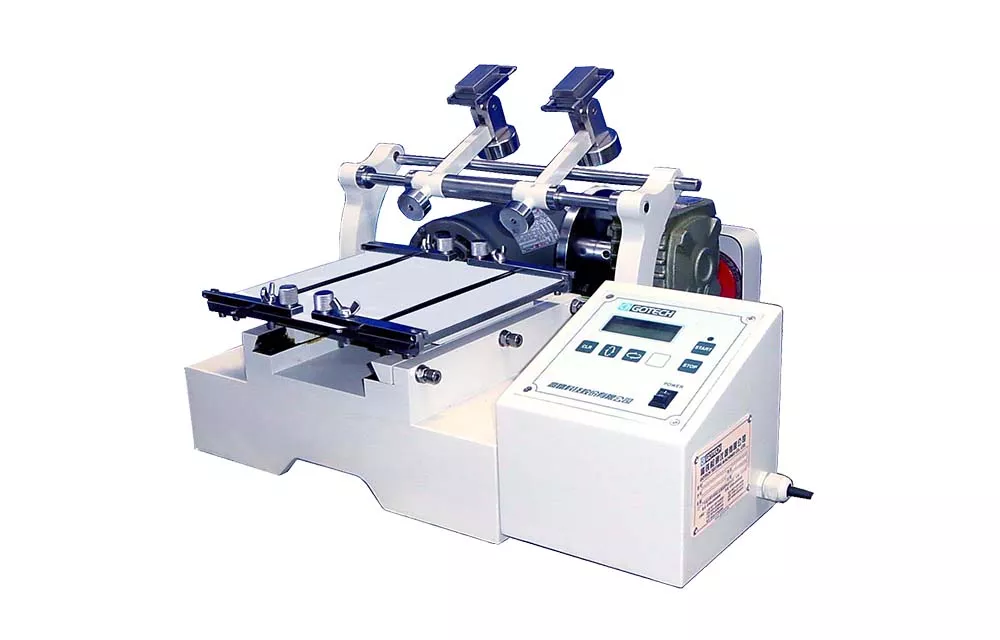
The main purpose of the wire printed material fastness tester is to evaluate the abrasion resistance and fastness of printed materials such as wires and cables after being rubbed by external objects. A wire about 300mm long is fixed on the table with the printed material facing upwards. A friction hammer wrapped in white cotton cloth is used to rub the printed material with a certain load, speed and reciprocating stroke to check the fastness of the printed material.
The degree to which the color of a sample changes during processing, testing, storage, or use.
The extent to which the color of the sample surface transfers to its adjacent material after rubbing.
After the test, the durability of the printed material can be visually assessed, including the degree of fading and potential contamination, which is crucial for evaluating product quality.
The test material’s printed surface performs under friction conditions, including wear resistance and abrasion resistance.
Assess the print’s durability when subjected to friction, i.e., whether it adheres firmly to the wire surface.
As a quality control tool in the production process, it ensures that products meet relevant standards and specifications.
Test results can serve as a reference for quality improvement, helping manufacturers to improve the design and material selection of printed text and enhance product quality.
This ensures that products comply with relevant industry standards and regulations, reducing risks and improving market compliance.
The wire printing fastness tester helps ensure that products such as wires and cables maintain the color stability of the printed material during actual use and provides information on the product’s abrasion resistance to meet relevant standards and customer expectations.
It has two testing systems, which can test two samples simultaneously, improving efficiency and increasing the number of tests.
Both dry and wet friction decolorization performance tests can be performed.
It features an intuitive and easy-to-use interface, reducing user learning time and improving efficiency.
| White cotton cloth | 70% rayon, 30% wool (self-provided) |
| Friction hammer load | 450±5 g |
| Friction speed | 28 CPM |
| Friction distance | 100 mm |
| counter | Electronic, 6-digit number; automatically stops after a set number of cycles. |
| volume | 56×55×37 cm |
| weight | 47 kg |
| power supply | 1∮, AC 220V, 2.6A (depending on country or specified) |
Villa Payung Indah B 27, Jawa Tengah, Pudakpayung, Kec. Banyumanik, Kota Semarang, Jawa Tengah 50265
Copyright 2023 Amtast Multisado