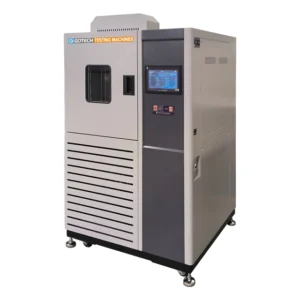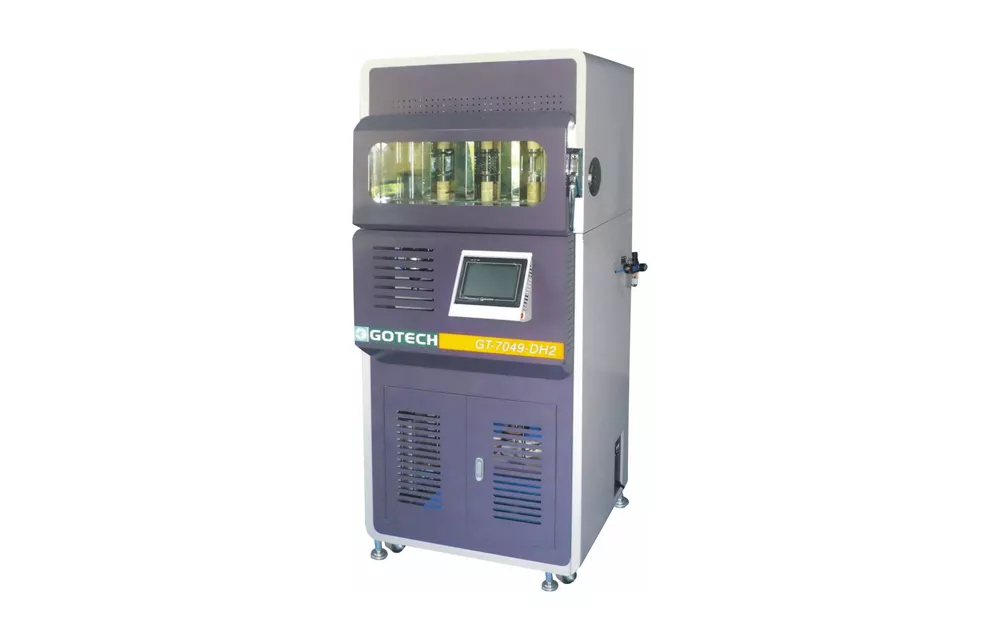
The high-temperature creep stress relaxation tester specifies a method for measuring the creep of vulcanized rubber under constant force and temperature, within a specified time interval, under continuous compression. It can determine the creep increment, creep index, and compliance increment of vulcanized rubber.
It is suitable for industries such as materials science, civil engineering, aerospace, academic research, and general industrial manufacturing.
When a constant strain is applied to rubber, the force required to maintain that strain is not constant; it gradually decreases over time.
When a constant stress is applied to rubber, the deformation that maintains the stress is not constant; the deformation gradually increases over time.
Creep refers to the deformation phenomenon that occurs in a material under certain stress and temperature conditions over a long period of time. Creep increment refers to the increase in creep deformation of a material over a certain period of time.
The creep index is a parameter relating the deformation rate to stress under creep conditions. The larger the value of the creep index, the more sensitive the material is to creep.
Compliance is the strain response of a material to applied stress, and the increase in compliance refers to the change in the material’s compliance under certain stress conditions.
This ensures that products comply with relevant industry standards and regulations, reducing risks and improving market compliance.
The high-temperature creep stress relaxation tester is used to evaluate the deformation properties of vulcanized rubber under high temperature and long-term loads, which is of great significance for engineering applications and product design.
If you have any further questions or needs regarding the high-temperature creep stress relaxation tester or other related equipment, please feel free to contact us.
We are dedicated to providing you with professional support and solutions.
With an intuitive and easy-to-use touchscreen interface, users can easily set test parameters and control the machine, improving the ease of operation.
It has excellent temperature control capabilities and can be tested in a wide temperature range from -70℃ to 250℃.
Employing a high-precision force measurement system, it can continuously measure compressive or tensile forces throughout the entire testing process, accurately measuring the stress relaxation and creep behavior of rubber materials.
It supports multiple testing modes, including stress relaxation, creep, dynamic and static testing, and allows you to select the appropriate testing mode to study the mechanical properties of rubber materials as needed.
By employing advanced control systems and testing software, automated testing and data acquisition can be achieved, greatly improving testing efficiency and accuracy while reducing the possibility of human error.
The testing machine is designed flexibly and can be customized and expanded as needed. For example, additional accessories can be added to support specific testing requirements.
| Control method | PLC+HMI |
| Temperature range | Normal temperature +10℃~250℃ |
| Temperature deviation | θ ≤ 100℃: ±1℃; 100<θ ≤ 250℃: ±2℃ |
| Number of test groups | 3 groups |
| Unit selection | kg, N |
| Deformation range | 0~10.00mm |
| Deformation error | ±1.0% |
| Deformation resolution | 0.01mm |
| Load range | Type A (430N, 540N, 750N, 1200N, 3300N, 7300N) tolerance: ±1% Type B (80N, 100N, 140N, 220N, 600N, 1300N) tolerance: ±1% |
| Test chamber dimensions (W×D×H) | 600×180×200mm |
| Machine dimensions (W×D×H) | 760×640×1830mm |
| power supply | 1∮220V 50/60Hz (depending on country or specific requirements) |
| air pressure source | 0.3~0.6Mpa |
Villa Payung Indah B 27, Jawa Tengah, Pudakpayung, Kec. Banyumanik, Kota Semarang, Jawa Tengah 50265
Copyright 2023 Amtast Multisado